9 mainstream and 9 pro-Russian or Russian-leaning websites, 1 January – 7 June 2025 (control) and the same span in 2026 (pre-election).
2025 · ~44 per 1,000
2026 · ~23 per 1,000
Contained
~23
Russian-origin citations per 1,000 mainstream articles, down from ~44
The pro-Russian cluster published ~16% more and pushed harder. The mainstream carried no more Russian-origin material per article.
concentrated in 1in, news.am and 168
about half the matched pairs are same-day
Cross-over
1,255
mainstream articles with Russian-origin text in 2026
Slightly fewer than in 2025. Most identical text shared across the two clusters is not Russian at all, but Armenian official announcements.
TASS / RIA / Interfax copy · ~75% → ~60%
Sputnik, RT · ~13% → ~24%
openly Kremlin-framed · ~4% → ~7%
Hardening
~24%
of the cross-over traceable to Sputnik and RT, up from ~13%
Word-for-word Russian agency copy still dominates, but its share is shrinking; state-media and openly Kremlin-framed material take its place.
Westward
~160
Western citations per 1,000 mainstream articles, up from ~60
By election season the mainstream leaned on Reuters, AP and AFP more than on Russian wires — a reversal of 2025.
Who cites what
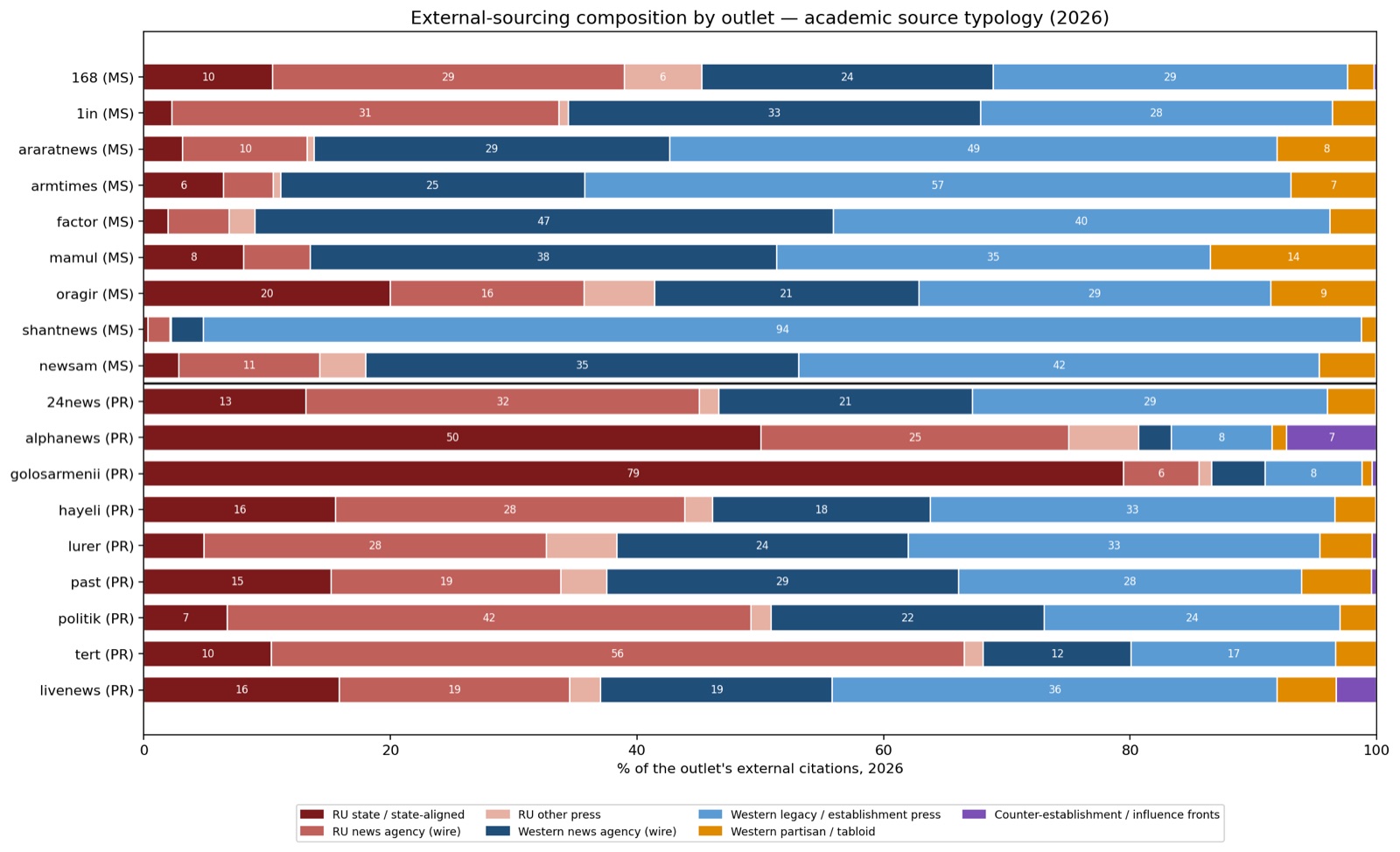
~85%
of the mainstream's external citations are Western
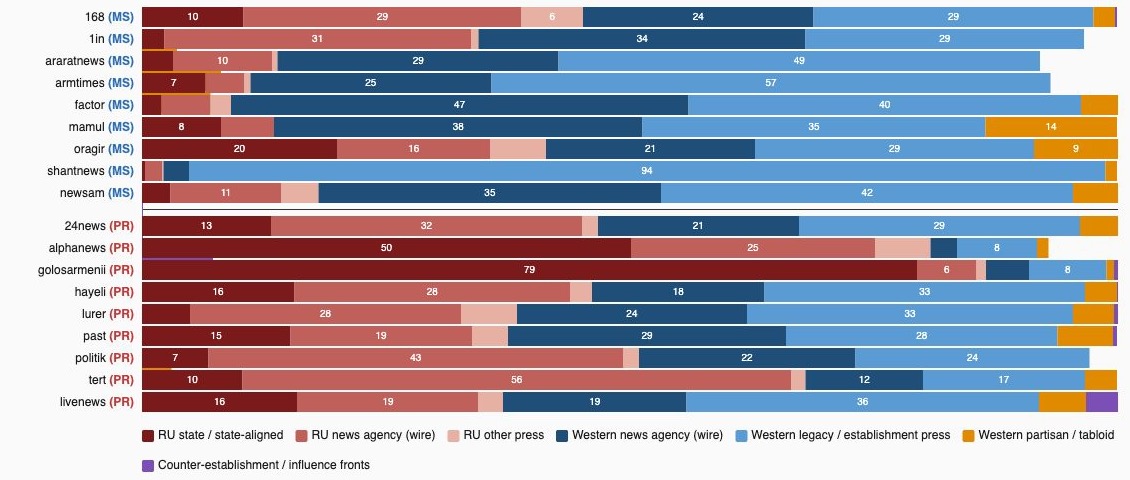
The pro-Russian cluster is ~60% Russian — golosarmenii at 79% Russian-state — yet still draws ~40% from Western outlets.
External-sourcing composition by outlet, 2026: mainstream above the rule, pro-Russian below (Qriton)
Sources by name
5,573
Sputnik mentions in the pro-Russian cluster
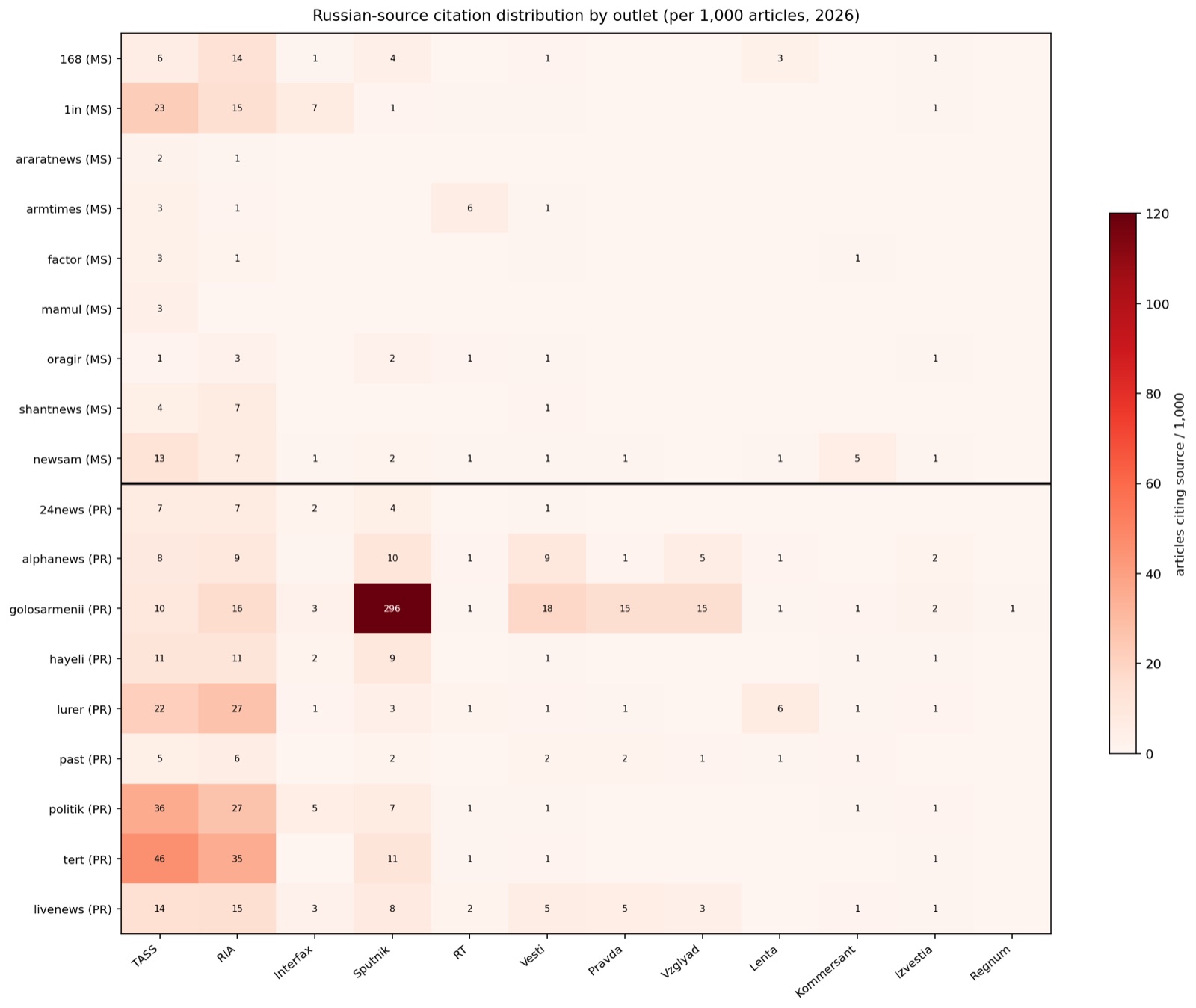
Then RIA 2,605 and TASS 2,528. The mainstream is wire-led (TASS 901, RIA 682); golosarmenii alone cites Sputnik at ~296 per 1,000 articles.
Russian-source citations per 1,000 articles, by outlet, 2026 (Qriton)
Strategic Culture Foundation · Alphanews, 25 articles
Berliner Zeitung · one Karapetyan interview, recycled
NYT quoted inside an "SVO against neo-Nazi Ukraine" frame
A closed register
19
op-eds cite a Western outlet inside a Kremlin frame
Concentrated in livenews — and none of them cross into a mainstream outlet. A register the cluster talks to itself in.
Regional sources
473
links to Azerbaijani state and pro-government media
From the pro-Russian cluster, against 195 — APA, AzerTac, Report.az and Caliber.az, carried chiefly by 24news, livenews and tert.
20 categories · ~95 surface forms
carried by golosarmenii, alphanews and 24news op-eds
a presence signal, read in context
Framing, by referent
≤3
articles per window use "junta" for Kyiv
Here "junta" means Turkey, Azerbaijan or the "Pashinyan junta". The prevalent frames are civilisational: collective West, anglo-Saxons, russophobia, Soros and foreign agents.
What it adds up to
The mainstream's information diet is diversifying toward the West, across every layer measured.
The pro-Russian cluster moves the other way: deeper into Russian state media, with a fringe front layer.
Penetration of the mainstream is real but narrow, and not expanding per capita.
Yet it is hardening: from agency copy toward state-sourced, framed content.