The Armenian Diaspora Before the Vote: Community Signalling & Contested Spaces Across Facebook Groups
Andra-Lucia Martinescu & Marius Dima · 13 October 2026
83 public Facebook groups · 1 March – 18 June 2026 · 204,552 posts by 7,395 authors · data collected with Apify
Key findings
- The diaspora is rarely named outright. Only 3,133 posts (1.5% of the corpus) use a direct term, while 28,451 refer to it through homeland, church, community, donation or election vocabulary; 89% of these never name it at all.
- Most of what these groups carry is reposted. Two-thirds of posts are reshares, just 12% get a comment, and the most active 1% of authors write 38% of everything. Most groups work as noticeboards for a small set of prolific posters.
- Different groups do different things with the diaspora. Broadcast and mid-size groups account for half of all diaspora naming, mostly in Latin script and mostly about memory. The big hubs are where it turns political: there the word appears in Russian, beside Russia and the vote.
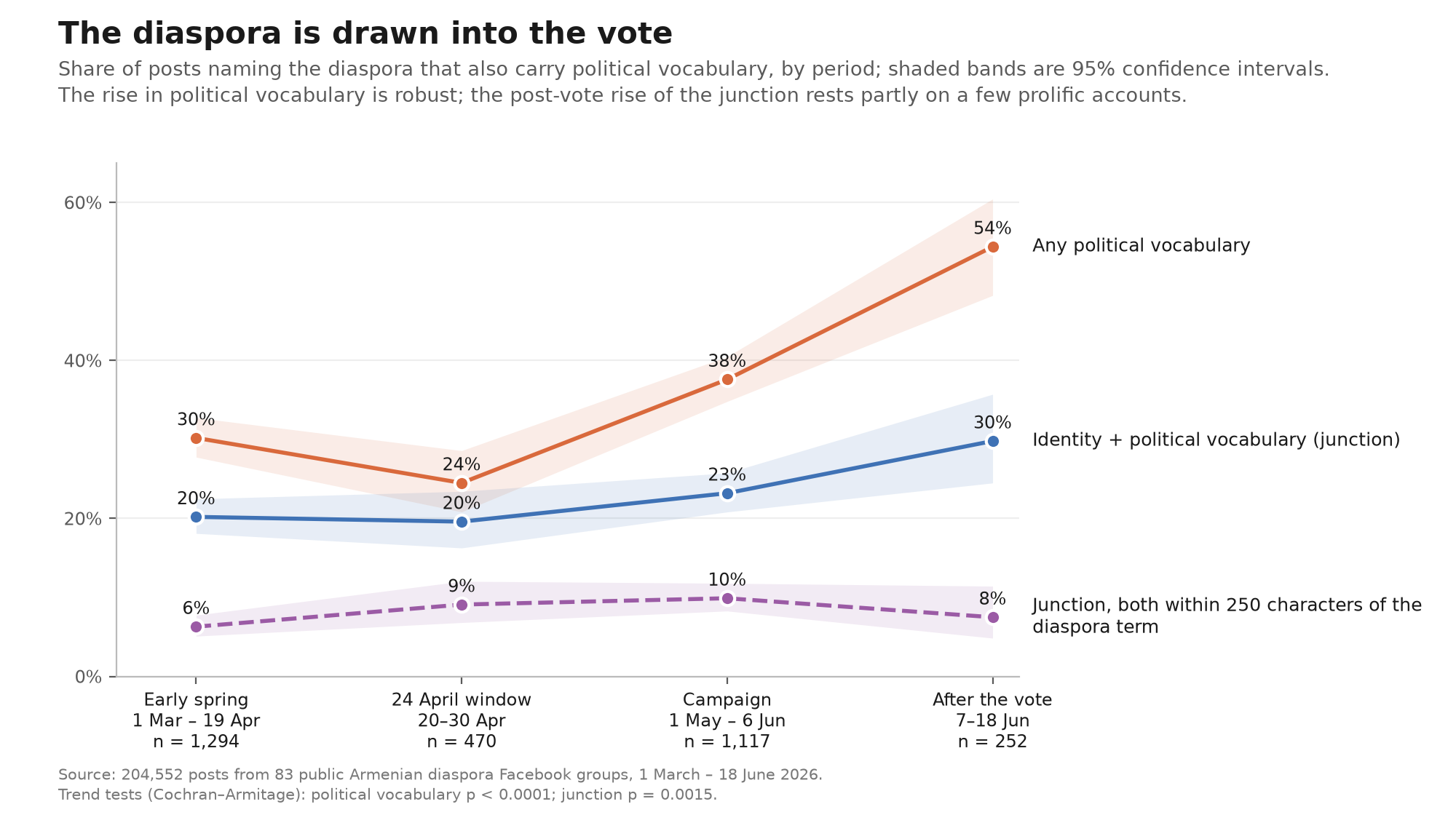
- Diaspora talk became more political over the period. The share of diaspora posts with political vocabulary went from 30% in early spring to 54% after the vote, with a dip around 24 April. The increase holds within groups, on distinct texts and without the most prolific posters.
- Both camps claim the diaspora and accuse the other of using it. Opposition voices cast it as a wronged constituency with the Church on its side; government supporters warn about diaspora voters coming from Russia. One side alleges organised voters from Russia, the other vote-buying with remittances.
- One voter-travel thread can be followed from start to finish. On 15 March Russia’s Armenians were offered help to come and vote; a second appeal followed in May, then a claim that ‘organised voters’ would arrive on 4 June, and the organiser’s arrest on 10 June. Posts relaying three media investigations connect the thread to Evrazia and to branches of the Union of Armenians of Russia. The Facebook data shows the offer; whether anyone travelled on it, we cannot say.
- The ARF is by far the most-named diaspora organisation. Groups based in Russia hardly mention diaspora institutions at all, and Russian cities turn up mainly in freight and travel ads.
- Giving for Artsakh is humanitarian and led from the Western diaspora. Russian aid appears once, as a pre-election delivery through Eurasia and Rossotrudnichestvo that Yerevan turned down.
Corpus and method
Our Facebook corpus comprises 204,552 posts by 7,395 distinct authors in 83 public Armenian diaspora groups, collected with Apify’s custom scraping tools and covering 1 March to 18 June 2026, eleven days after the ballot. A radiography of these groups reveals a diverse landscape of community interests and online diasporic public spheres, at least on the surface. At one end sit very large general-purpose hubs such as ЕСЛИ ЛЮБИШЬ АРМЕНИЮ (‘If You Love Armenia’, some 20,000 posts) and Armenians of the World / Աշխարհի Հայեր; at the other, city- and country-based communities in France, the United States, Canada, Russia, Georgia, Cyprus, Germany, Belgium, Iran and the Holy Land, among others.
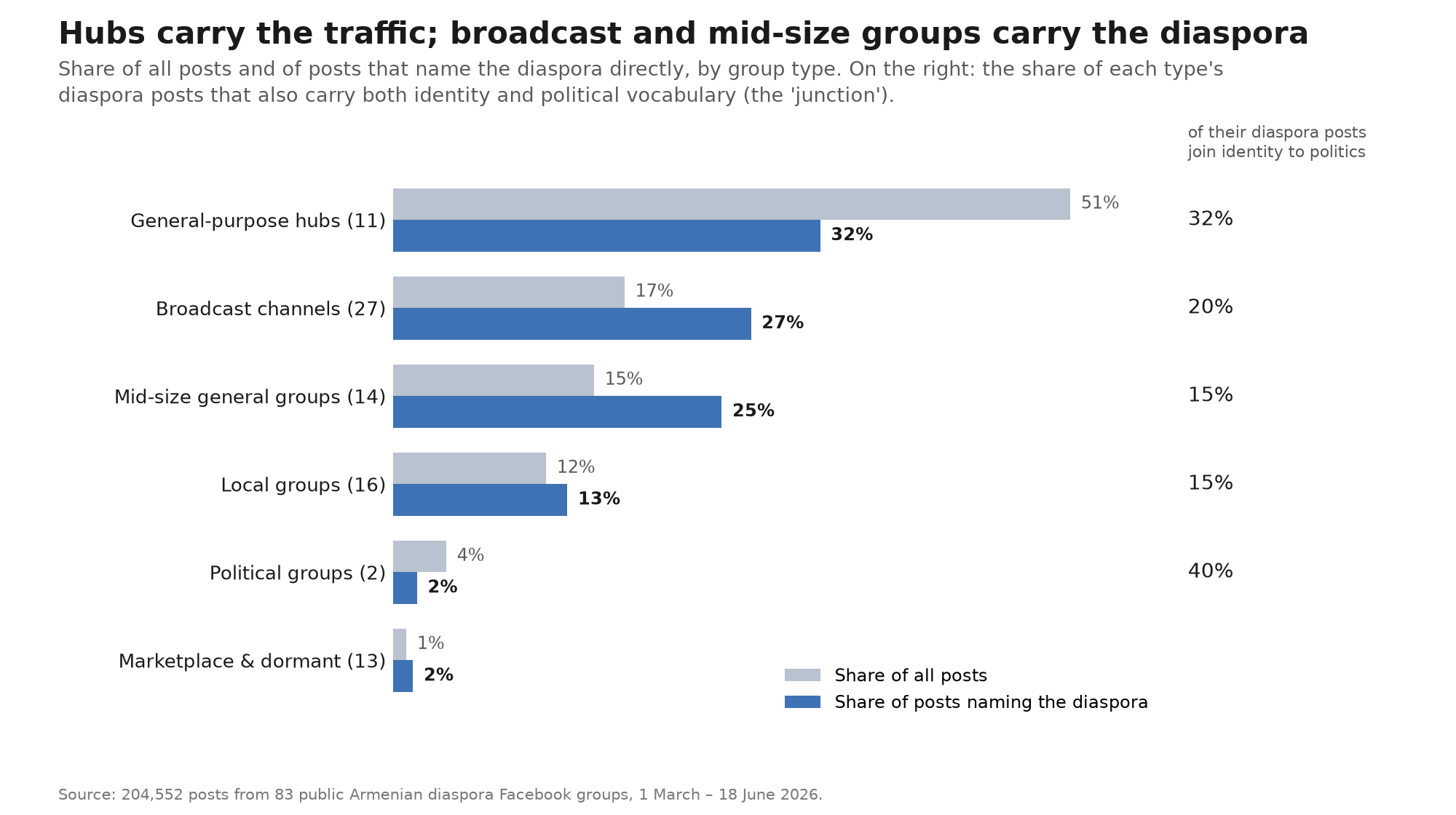
We sorted the 83 groups into types by size, participation, how concentrated their authorship is, interaction and content. Group sizes are very uneven, so we describe each type by its median group, which stops a single very large or very small group from setting the profile, and give pooled shares alongside to show where the volume is. The 11 general-purpose hubs carry 51% of all posts and have a median of about 500 authors; examples are ЕСЛИ ЛЮБИШЬ АРМЕНИЮ, Armenians of the World, Armenians in Moscow and Armenians of All Countries, Unite. They mix news reshares, greetings, commerce and politics, and they are the main route to a large audience. In the 27 broadcast channels (17% of posts) the ten most active accounts write a median of 87% of posts; these are news aggregators and single-editor pages. Together with the 14 mid-size general groups (15% of posts), they have the highest share of diaspora vocabulary, a median of 2.7% of posts. The 16 local groups (12% of posts) are city- or country-based communities in France, the US, Belgium, Cyprus and Russia. They carry the most commercial and service content (median 12.5% of posts), although commerce is still a minority of what they post. Two political discussion groups (4% of posts) give a median quarter of their posts to political vocabulary. One marketplace group (0.7%) and twelve small or dormant groups (0.3%) make up the rest.
Overall, the diasporic public that appears in these groups is dominated by a few large hubs and by broadcast-style channels, and real interaction is limited to a few local groups and a minority of participants. It is easy to overestimate how plural this space is. Activity is concentrated: the five largest groups hold 31% of all posts and the ten largest 49%; the most active 1% of authors write 38% of posts; 30% of authors post in more than one group and 7.7% in five or more. Two-thirds of posts (65%) are reshares with little or no text of their own, and replies are rare (see ‘Where discussion happens’). What looks like a set of separate communities works more like a circulation system, in which a small number of prolific posters move content across many groups. Most groups distribute content; few are places where people argue about it. They signal belonging but mostly carry traffic, and the way the platform works reinforces this.
Our approach rests on a referential premise. Transnational audiences are spread across jurisdictions, platforms and languages, and diasporas are reached through the vocabulary of their institutions and attachments: church, community, homeland, remembrance and solidarity. We therefore treat the reference itself as the unit of analysis and work in two stages, matching word stems in four written registers. Direct references are the explicit terms. In Armenian these are սփյուռք/սփիւռք (spyurk, ‘diaspora’) in its reformed and classical spellings, a split that can indicate provenance, since writers based in Armenia and Russia use the reformed spelling and the traditional Western diaspora the classical one; գաղութ (gaghut, literally ‘colony’), the older Western Armenian word for a diaspora community, still used in Beirut- and Paris-lineage media, of which we count only the community senses; and արտերկրի հայեր (‘Armenians abroad’). In Russian they are диаспора and соотечественники (‘compatriots’). The latter is the Kremlin’s own term for co-ethnics abroad, so its appearance in content for Armenian audiences can be a signal in itself. In Latin script we match diaspora and spyurk. The second stage captures community signalling, meaning how the diaspora is invoked and mobilised, through five indirect families (not an exhaustive list): homeland and compatriot appeals (հայրենիք, հայրենակից, repatriation); community organisations, such as the Armenian General Benevolent Union (AGBU), the Hamazkayin Armenian Educational and Cultural Society, the Armenian National Committee of America (ANCA), the Armenian Revolutionary Federation (ARF, Dashnaktsutyun) and Armenian schools; the church (Etchmiadzin, the Catholicos, the liturgy, the dioceses); donations and remittances (fundraising, telethons, payment channels); and election vocabulary (voting, ballots, polling stations, the 7 June date). Six contextual families show the setting of a reference, whether it is commemorative, humanitarian or partisan, and often its geopolitical leaning: genocide memory, Artsakh (Karabakh), the government, the opposition, Russia, and the West (the EU, the US, NATO and the TRIPP corridor). We checked each lexicon against random samples of matches and pruned ambiguous stems, for instance ընտրություն in the sense of ‘choice’, համայնք meaning ‘municipality’, and Karapetyan as a common surname.
About 77% of posts have fewer than ten characters of their own text, so we read each post together with the text it reshares, its link title and the text the platform recognises in its images. Among posts with at least twenty letters of readable text, Armenian script is the most common (89,952 posts), then Latin (47,846) and Cyrillic (14,838). To see how vocabulary families go together, we compare the share of posts in one family that also contain a second with the same share in all other posts. For example, 21% of diaspora posts mention the church, compared with 3.6% of other posts. We report each association with four checks: a comparison within groups (a Mantel–Haenszel ratio), so that a few groups cannot produce it on their own; distinct texts only, so that copy-pasted posts count once; the same figures without the ten most prolific accounts; and a proximity test that requires both terms within 250 characters of each other. Hashtags are sorted into the same families. We follow the material across four periods: early spring (1 March to 19 April), the 24 April commemoration window (20 to 30 April), the campaign (1 May to 6 June) and the period after the vote (7 to 18 June 2026), and mark the events the corpus itself picks up (Table 1).
Who does what: group types
The group types do different work (Figure 1). Broadcast and mid-size groups hold a third of all posts between them but produce half of all diaspora references, mostly in Latin script and around memory and community; genocide remembrance appears in 28–30% of their diaspora posts. The general-purpose hubs carry half of all traffic and only a third of direct diaspora references. In these groups, however, the word is most often written in Russian (40% of hub diaspora posts) and sits next to Russia (26%) and the vote, and one in three of their diaspora posts combines identity and political vocabulary. Local groups are where diaspora posts most often get an answer: 20.5% draw a comment, against 14% in the hubs. The two political groups rarely mention the diaspora, and when they do it is almost always in a political context (40% of their diaspora posts combine identity and political vocabulary).
Armenians of All Countries, Unite (ՀԱՅԵՐ ԲՈԼՈՐ ԵՐԿՐՆԵՐԻ, ՄԻԱՑԵՔ) shows the hub pattern clearly. Three in four of its posts are reshares and one in a hundred gets a comment. It names the opposition twice as often as the other hubs (10.2% of posts against 5.8%). Of its 69 posts that name the diaspora, 35% combine identity and political vocabulary, the combination we call a junction. Nine in ten of these diaspora posts also appear, word for word, in ЕСЛИ ЛЮБИШЬ АРМЕНИЮ, Armenians of the World, Hayer Moskvayum and the Moscow groups; the group is one relay in a Russian-language reposting network. Most of what it passes on supports the opposition: the National-Democratic Pole’s election declaration (3 April, post ↗); ‘Kocharyan, symbol of the unity of Artsakh, Armenia and the Diaspora’ (20 April, post ↗); Prosperous Armenia’s ‘Offer to Armenia’ programme, posted in three languages (12 May, post ↗); the argument that ‘diaspora investment in the homeland must serve political goals’ (15 March, post ↗); and an attack on the ARF as ‘KGB… drinking the Diaspora’s potential’ (17 March, post ↗). What these posts have in common is a view of the diaspora as a political resource, in this case one to be used against the government.
One thread in this stream bears directly on the free-transport allegation that circulated around the vote, and shows how it travelled on Facebook. On 15 March a post headed ‘Armenians of Russia, attention’ responded to Pashinyan’s claim that voters living in Russia would back him. It invited ‘those who want to take part in the elections but lack the means’ to write to the Telegram contact @mbadalyan: ‘I will try to help everyone… on 7 June we must all be in Armenia’ (post ↗). The handle belongs to Mika Badalyan. The same text went up that day in five groups of one reposting network: Armenians of All Countries, Unite, Armenians of the World and three Moscow groups. The thread can be followed to its end. On 24 May an ‘appeal to the Armenian diaspora of Russia’ again sent readers to the same handle (post ↗). On 3 June a post claimed that ‘voters organised by Mika Badalyan’ would arrive in Armenia on 4 June and that a report had been filed (post ↗). On 10 June came news of a court decision to arrest him (post ↗). These posts document an offer of help to travel and vote. Whether free transport was actually provided, our data cannot tell us.
Two more posts fill in the background. On 10 April a text signed by Badalyan and posted in ЕСЛИ ЛЮБИШЬ АРМЕНИЮ told Armenian business that Moscow had given Pashinyan a ‘black mark’. Citing the case of the Proshyan brandy factory, it warned that ‘the time of neutrality is over’, that silence now counted as support for the regime, and that those who ‘cling to the departing prime minister will go down with him’ (post ↗). On 5 and 6 June a post in Armenians of the World and PROUD TO BE ARMENIAN answered those who say ‘there is no direction from Russia, people come to vote out of love for the homeland’ (post ↗). It pointed to three media investigations. Factor had looked into the activities of ‘one of the organisers, the notorious Mika Badalyan, and his Eurasia’. A CivilNet Check journalist had contacted Badalyan posing as a Russian Armenian and asked for a ticket. A journalist from the Fact-Checking Platform (FIP), presenting himself as an FSB officer, had phoned the heads of several branches of the Union of Armenians of Russia, who described how Armenians in Russia were being recruited for the election. The post also said flights were up by about 30% on the same period a year earlier. We report these as claims made on Facebook. The investigations themselves are outside this study and should be cited directly.
Where discussion happens
Groups named after a place do not have more organic diaspora discussion than transnational ones. Their diaspora posts carry original text about as often (31% against 28%) and appear in only one group about as often (20% against 22%). They are commented on slightly less (14.5% against 15.9%; 0.9 comments per post against 1.7), and early spring makes no difference (13% against 15%). In both sets, posts get the most replies after the vote (20–23%). Discussion is more common in the groups we typed as local communities and in the Middle Eastern groups, where 21% of diaspora posts are commented on, and least common in the North American (5%) and smaller European groups (10%). Where organic posts do appear, they are about community life (Amshen dance rehearsals in Abkhazia and Adler, Canadian parents worried about passing on the language), institutional disagreement (the CCAF objecting to a government decision on 28 April), or partisan argument, mostly pro-government translation threads in one French group urging readers to ‘isolate the ARF fractionists in the diaspora’. Even these get few replies: the most-commented diaspora post that appeared in only one group has 17 comments. People do talk in local groups, but not much, and that is not where the political language about the diaspora comes from.
Who speaks for the diaspora: organisations
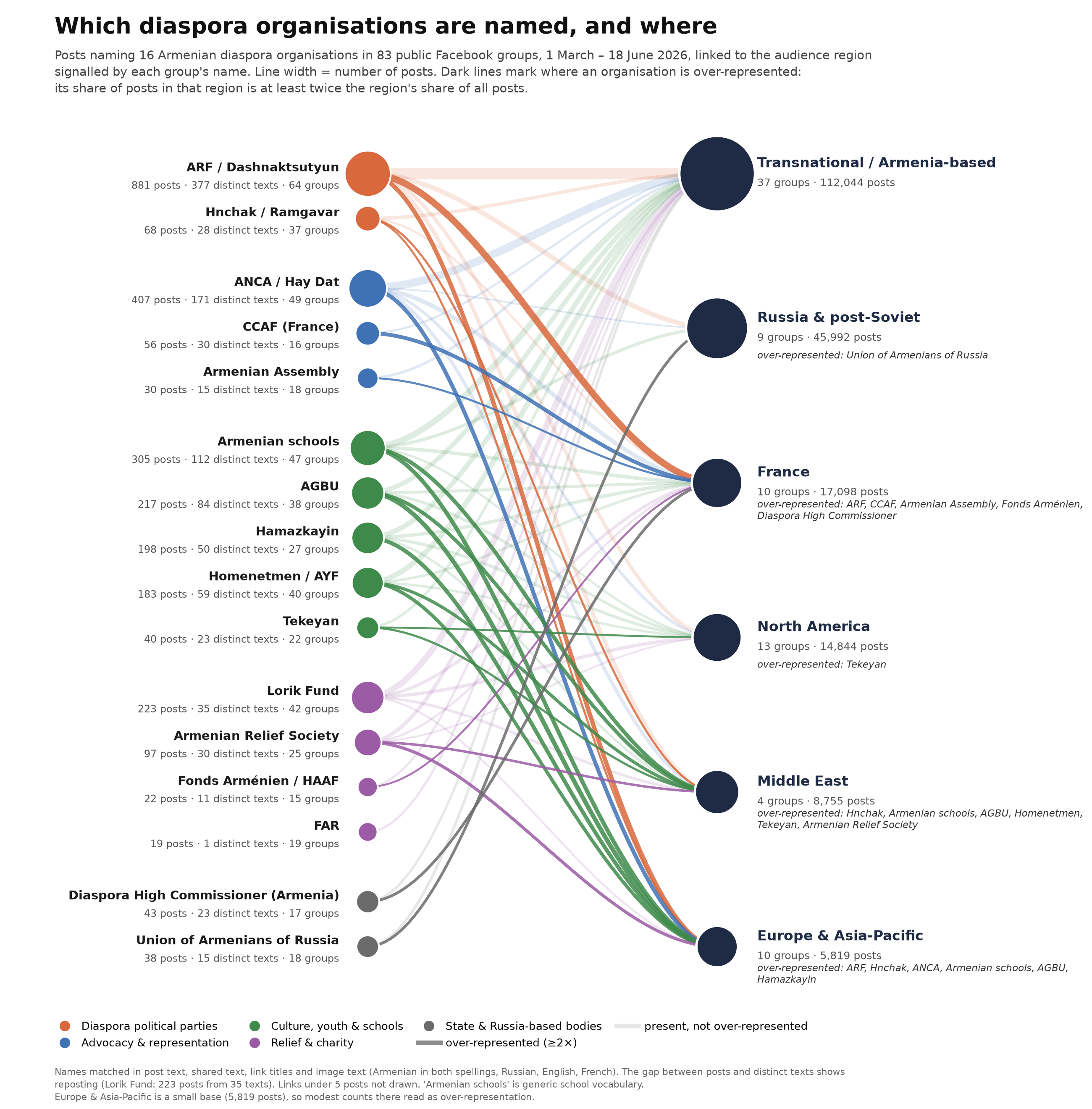
Fifteen diaspora organisations, plus general vocabulary about Armenian schools, are mentioned 2,827 times (Figure 2; one post can mention more than one). The ARF (Dashnaktsutyun) is mentioned far more than any other, in 881 posts and 377 distinct texts across 64 of the 83 groups: twice as often as ANCA (407) and four times as often as AGBU (217). It is also the most political. Of its mentions, 19% come with Russia and 17% with the government, against 2–10% for the cultural bodies. Its mentions peak in early spring, when the ARF both organised the Paris conference and came under attack over it.
The pattern splits three ways. French groups talk about the representative and advocacy bodies: the ARF at twice the rate their size would predict, the CCAF almost only there (79% of its mentions, mostly around the 24 April dispute in Marseille), and Armenia’s Diaspora High Commissioner (5.6 times). The Middle Eastern and smaller European groups mention the institutions of the classical diaspora, such as AGBU, Hamazkayin, Homenetmen, the Armenian Relief Society and the schools, at two to ten times their share. The Russia-based groups, a fifth of all posts, hardly mention any of these (AGBU and Hamazkayin not at all, ANCA five times). The one organisation over-represented there is the Union of Armenians of Russia, which a fact-checking investigation relayed on 5 June linked to recruiting voters for the election. Russian-speaking Armenians are addressed as compatriots and voters, with no reference to community institutions. Volume can also mislead. Lorik Humanitarian Fund’s 223 posts come from only 35 texts, three-quarters of them posted during the campaign, so its prominence reflects reposting effort as much as presence.
How the diaspora is referred to
Direct diaspora references appear in 3,133 posts, or 1.5% of the corpus (1,181 distinct texts, in 77 groups, by 476 authors). With the indirect vocabulary included, 28,451 posts refer to the diaspora in some way, and 89% of them never use a direct term. Election vocabulary is the largest family (11,687 posts), followed by the church (7,973) and homeland appeals (7,118). Organisational vocabulary (3,038) and donation appeals (1,739) are much smaller.
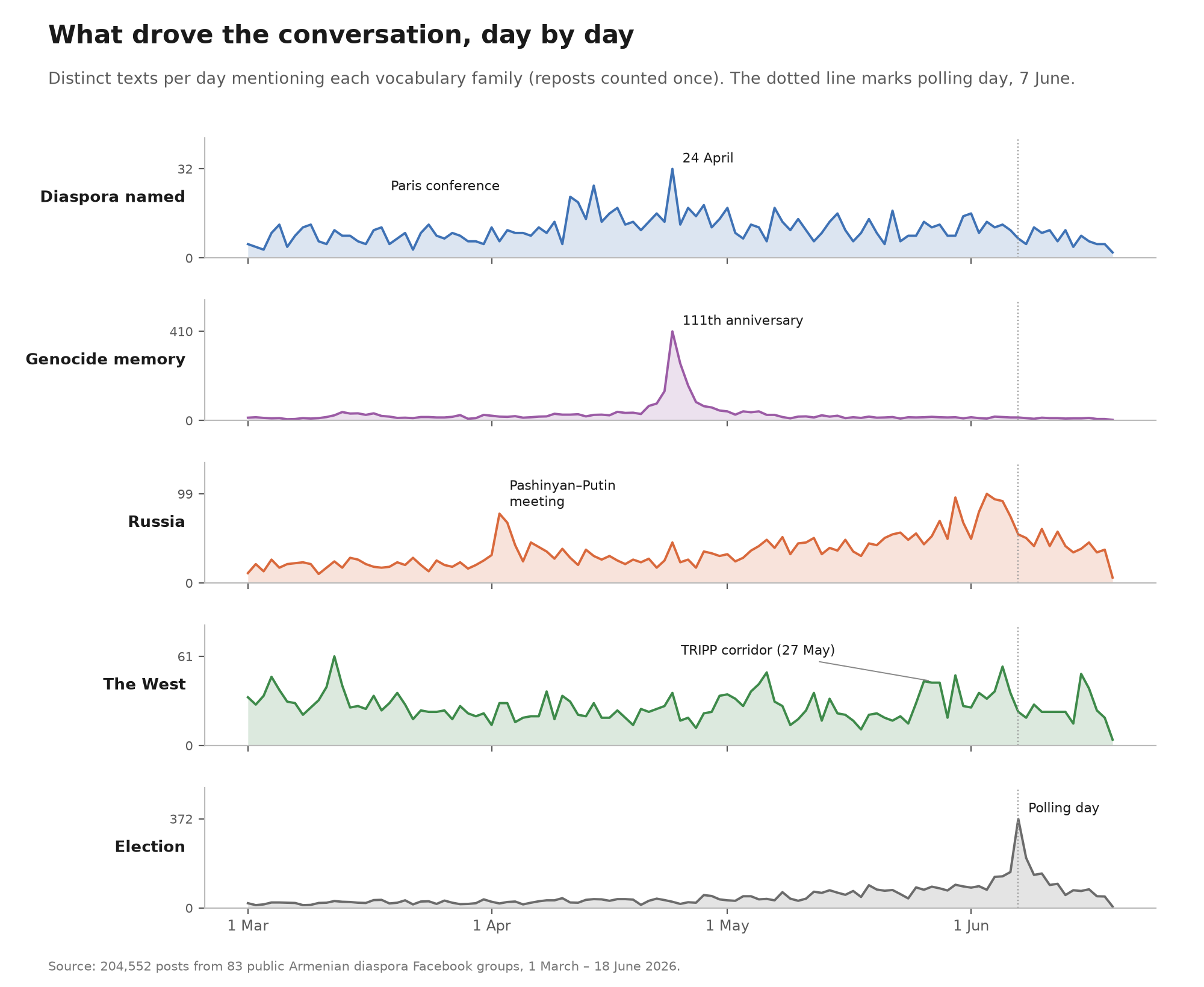
Over the four periods the picture changes. In early spring diaspora naming is spread thin, with no single text above 4.3% of it, and it peaks on 11–14 April with the Paris Diaspora Mobilisation Conference (see below). Around 24 April, genocide memory rises to 15.5% of all posts and appears in 51% of diaspora posts. During the campaign, direct references fall to 1.3% of posts while election vocabulary doubles (6.6% of posts, against 3.4% in early spring). Within diaspora posts the company changes too: Artsakh (22%), Russia (16%), the government (12%) and the West (9%). The registers also split by language. French-language posts are reflective essays on denial, exile and réveil (awakening); Russian-language ones speak of ‘армяне за рубежом’ (Armenians abroad). After the vote, election vocabulary reaches 12.3% of all posts and diaspora posts become openly geopolitical: 31% mention Russia, 24% the government and 16% the West.
After the vote the vocabulary is about the election itself. Posts claim to know how ‘the world’s Armenians’ voted (‘95% of the world’s Armenians did not vote for Nikol Pashinyan’, post ↗) and report a proposed residency rule that would stop citizens who have been abroad for six months from voting (post ↗). In Russian, one text dominates. On 13 June an open letter signed ‘Ararat Voskanyan’ appeared in eight groups within a few hours, posted by two accounts; seven of the groups are Russia-based or Russian-language (post ↗). It is written as an answer to the question ‘What do you think of relations between the Armenians of Russia and the Armenians of Armenia?’ and still has the bold markers and section headings that text pasted from an AI chat window usually carries. It addresses readers as ‘dear compatriots’ but does not follow the Kremlin’s line on compatriots. It calls Russia’s Armenian community ‘one of the largest, most influential and successful in the diaspora’, warns that Armenia depends dangerously on remittances from Russia, and urges Russia’s Armenians to invest, to think about returning, and to lobby for Armenia ‘in Russian corridors of power, but not at the expense of the homeland’s sovereignty’. It names no party or candidate. A second letter two days later (‘Armenia without Armenians: the last chance to save the nation’) is about emigration. So the Russian-language material after the vote comes down to one conciliatory, probably machine-drafted letter pushed through one reposting network. It says little about how Russian-speaking groups in general write about the diaspora.
Over four months, then, the diaspora goes from a community talking about its own identity to a subject of Armenian domestic politics, discussed more and more in terms of Russia and of the prime minister. The close mixing of identity and voting language belongs to the campaign and is concentrated in a few prolific accounts. That pattern fits organised amplification better than people arriving at the same language on their own.
What drove the peaks
We count a spike when the number of distinct texts in a family on a given day is at least twice its 14-day running median and at least three robust standard deviations above it (Figure 3, Table 1). The sequence runs from Russia in early April to the diaspora (Paris) and memory (24 April), then to the West (the TRIPP corridor, late May) and finally the vote (7 June). Only the 24 April peak involves a large number of accounts. Most of the others come from one to four accounts reposting the same text in many groups, which matches the circulation pattern described earlier.
| Date | Signal | What drove it |
|---|---|---|
| 15–17 Mar | genocide ×2.9 | Tehlirian anniversary essays; claims that the Genocide Museum’s Artsakh section would close |
| 18 Mar | Artsakh ×2.0 | One account’s claim, reposted in 8 groups, that schools were closed ‘to accommodate 300,000 Azeris’ |
| 29–30 Mar | church ×2.6 | Israeli police bar the Palm Sunday mass at the Holy Sepulchre; a citizen confronts Pashinyan in church (‘the Catholicos is not a minister you appoint’) |
| 2–3 Apr | Russia ×3.8 | Pashinyan–Putin meeting in Moscow (1 April); rally for the Church at Armenia’s embassy in Moscow; claim that Putin called Karapetyan ‘his man’ |
| 11–14 Apr | diaspora ×2.7, community ×2.8 | Paris Diaspora Mobilisation Conference |
| 21–26 Apr | genocide up to ×13.9, diaspora ×2.4 | 111th anniversary: reported destruction of the Stepanakert cathedral (21 April), Marseille’s Palais du Pharo illuminated, commemorative essays and exhibitions reposted across many groups |
| 15 May | donation ×2.4 | Monastery-renovation and former-hostage appeals |
| 26–30 May | West ×2.0–2.3 | TRIPP corridor: ‘De facto surrender’ (28 copies in 28 groups from two accounts, 27 May); scepticism of US guarantees |
| 7–8 Jun | election ×4.3 | Polling-station reports (unsealed ballot box in Shengavit, ballots removed in Lori, pressure on voters in Goris); soldiers allegedly bused in; the Pole’s statement on a ‘seizure of power’ |
| 15–17 Jun | West ×2.0, community ×2.1 | EU and Russia–Turkey treaty commentary; Cyprus diaspora (Melkonian) anniversaries |
Table 1. Spike days by vocabulary family (distinct texts per day, multiple of the 14-day running median) and the texts that drove them.
Places
Place names show where the diaspora vocabulary is located. We extracted 46 places from post text in Armenian (both spellings), Russian, English and French, and classified the 170 characters on either side of each mention. Across the corpus the map is centred on Armenia. Yerevan is named in 10,295 posts, followed by Moscow (3,284), Los Angeles and Glendale (2,559), Syunik (2,192), Beirut (1,814), the towns of historical Western Armenia (1,634), Baku (1,426), Gyumri (1,327) and Paris (1,300). Posts that name the diaspora point elsewhere (Figure 4). About 18% name a place in Armenia, 12% a place in France, 9% a town of historical Western Armenia or Istanbul, 9% Lebanon, 6% the United States and only 5.6% a place in Russia. Paris is the most diasporic city, with 306 diaspora posts and community vocabulary in 18% of its mentions. Aleppo and Istanbul come up mostly in connection with the genocide (24% and 26% of mentions), Beirut with war and security, Stepanakert with its churches, and the Lachin corridor with the war.
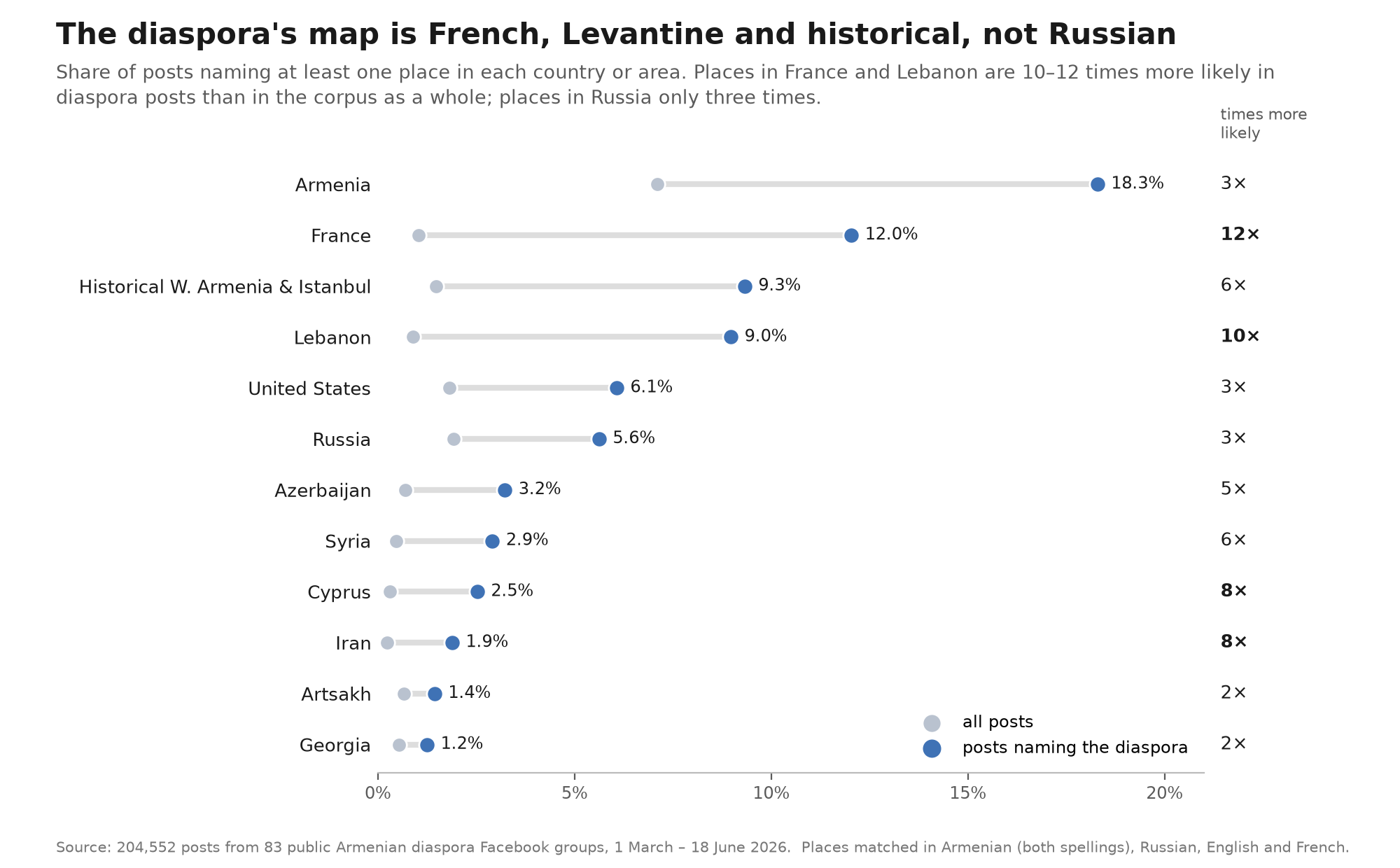
Russian places appear in a different context. Rostov-on-Don is mentioned in a commercial or transport setting 72% of the time, Krasnodar 33%, Tbilisi 26% and Moscow 24%, with Moscow appearing a further 32% of the time in a geopolitical one. Places in Russia appear in 3,917 posts, but only 176 of those name the diaspora. The Russian-Armenian community shows up mainly as a logistics corridor, with freight, car-sharing and transfers between Russia, Georgia and Armenia, and seldom as a diaspora. Groups named after a place outside Armenia also look homeward more than at their own city. The Russia-based groups name Moscow in 6% of their diaspora posts and Yerevan in 19%; the French groups name Paris (16%) and Marseille (7%) about as often as Yerevan (15%).
Where identity meets the vote
We call a post a junction when it combines diaspora-identity and political vocabulary. Among diaspora posts, the share with any political vocabulary rises from 30% in early spring to 54% after the vote, with a dip to 25% around 24 April (Figure 5; Cochran–Armitage trend test, p < 0.0001). The rise holds within groups, on distinct texts and without the most prolific posters. Junction posts rise less, from 20% to 23% during the campaign. Their further rise to 30% after the vote depends partly on a handful of prolific accounts, and if we require both vocabularies to sit within 250 characters of the diaspora term, the share peaks during the campaign at about 10%. Junction posts are concentrated in the general-purpose hubs (32% of their diaspora posts, against 22% overall, and 46% of all junction posts) and in the Moscow-based groups. The French groups supply a fifth of them, at an average rate. Counted by posts, junctions draw mostly on Russia (42%) and election vocabulary (42%). Counted by distinct texts, election (49%) and government (40%) vocabulary lead, so Russia’s high share comes from heavy reposting. Across the whole corpus, domestic politics comes in through election vocabulary: 31.9% of election posts name the government (against 6.9% of other posts), 22.6% the opposition (4.1%) and 11.4% Russia (3.4%), and 17.6% of homeland posts carry election vocabulary (5.2%).
The strongest junction texts fall into a few groups. Some call on the diaspora as an electorate (‘those living abroad now outnumber the homeland three times… voters must vote right’). Others try to mobilise against diaspora voters, especially those in Russia (‘if you come to Armenia to vote [remember why] you left’). Many treat diaspora rights as a grievance: the loss of the vote, entry bans, the ‘foreign agents’ label. The Church is presented as the diaspora’s anchor against the government, from Etchmiadzin’s condemnation of the Civil Contract programme to a sermon in a Moscow group that speaks of Satan acting ‘through people like Nikol Pashinyan’. Parties present themselves as the diaspora’s champion: Kocharyan most consistently, Karapetyan as a ‘national benefactor’ endorsed by the Catholicos, Prosperous Armenia with dormitories for returning students. There is an argument about who speaks for the diaspora, over the Paris conference and over France’s CCAF (its southern branch pulling out of the 24 April commemoration in Marseille, its objection to a government decision, and a later article linking it to a Russian hybrid operation codenamed ‘Marseille’). Diaspora money is recast as vote-buying in two claims from one French-Armenian group. And there is the question of geopolitical direction, from calls for neutrality to calls for a clean break with Russia, and the pro-government ‘Two Armenias’ essay. Taken together, these texts show the two sides competing for the diaspora. The opposition posts far more, presenting the diaspora as a wronged constituency that the Church defends and that every opposition party courts. Each side accuses the other of exploiting it, with organised voters from Russia on one side and remittance vote-buying on the other. In all of this the diaspora seldom speaks for itself; it is mostly something the two camps argue over, in the language of identity.
The Paris Diaspora Mobilisation Conference
The conference on 11–12 April is the biggest single diaspora event in the corpus: 195 posts and 71 distinct texts in 32 groups, though from only 27 accounts, three of which posted two-thirds of the total. It was announced on 7–8 April in Armenian, in Western Armenian and in an English agency text as a response to ‘the unprecedented crises that have shaken the Armenian world’. Coverage peaked on 12 April and stayed high until 16 April. Posts reported 150 to 169 delegates from 25 or 26 countries, messages from both Catholicoi, a speech by ARF Bureau member Daron Der-Khachadourian, a video address by the mayor of Glendale, a panel on Armenia–diaspora relations with former prime minister Vazgen Manukyan, and a wreath at the Komitas statue. The closing declaration called for stronger diaspora communities, for keeping the Artsakh question open, and for ‘the imperative of political change in Armenia’ (post ↗). One delegate was blunter: ‘on 7 June it will be decided whether the Third Republic has guardians’.
This is the main Western Armenian event in the corpus. Of the conference’s Armenian-script posts, 56% use classical orthography, compared with 7–12% of diaspora posts overall. Coverage is framed above all by Artsakh (43%), then genocide memory (25%) and the vote (23%); Russia hardly features (5%). Criticism was less common but kept coming (26% of posts, 14 distinct texts): ‘organised by the ARF… to show that the diaspora supports the pro-Russian line’ (11 April, post ↗); ‘National mobilisation or ARF mobilisation?’ (12 April, 11 copies in 8 groups, post ↗); ‘Macron talks of opening borders, the Dashnaktsutyun organises division’ (14 April); ‘behind the Diaspora congress act the forces of the Kremlin’ (26 April, post ↗). On 8 May a Western Armenian summary went round again, in 12 groups. Supporters described the conference in terms of memory and Artsakh, critics in terms of the ARF and the Kremlin. Five weeks before the vote, nobody on either side treated it as anything other than political.
Artsakh and giving
Artsakh has long been one of the main reasons the diaspora gets involved. Care for the people displaced in 2023 still runs through the diaspora’s established humanitarian networks, even though the peace process has pushed the issue down the agenda. In this corpus donations and Artsakh go together. About 10% of donation posts mention Artsakh, compared with 5% of other posts, once boilerplate from a history channel is taken out (12.3% against 5.2% before). Most of this giving is humanitarian and comes from the Western diaspora. About two in five of the posts that combine donations and Artsakh relay a single US charity, Lorik Humanitarian Fund, which gives small-business grants and scholarships to displaced families; one of its appeals ran to 26 copies in 23 groups (post ↗). Others come from the Fonds Arménien de France, Santé Arménie and the Anna Astvatsaturian Foundation, and there are individual appeals for wounded soldiers and their families in the Moscow groups. Partisan use is rare. A pro-government post called an ANCA fundraising letter about Artsakh a ‘scam’ to ‘extort money from diasporans’ (11 April, post ↗), and Samvel Karapetyan’s philanthropy is passed around as campaign material.
Russian humanitarian aid comes up only once, and as a political story before the election. On 13 March two posts reported that Yerevan had refused Russian aid for Karabakh refugees ‘ahead of the 7 June elections’. It was to be delivered through the Russian Humanitarian Mission, the Eurasia organisation (previously linked to interference in Moldova’s 2024 referendum) and Rossotrudnichestvo. GlobalHye posted the news as a warning (post ↗); ЕСЛИ ЛЮБИШЬ АРМЕНИЮ posted it with the boast that ‘aid from Russia reached the Artsakh people anyway’ (post ↗). Russian peacekeepers come up in about a dozen posts, mostly blamed for the blockade and the 2023 exodus.
VOMA (Ողջ Մնալու Արվեստ, ‘the art of survival’), a military-patriotic training NGO, is the clearest example of security-minded mobilisation aimed partly at the diaspora. It appears in 101 posts (59 distinct texts), but only 13 accounts post about it, the top three accounting for 83%, and two hubs, Armenians of All Countries, Unite and Armenians of the World, carry two-thirds of it, mostly in early spring. The posts advertise free courses in Yerevan, Vanadzor, Alaverdi and Gyumri and an intake for 15–17-year-olds. They promote a ten-day field camp in Atan (Lori) on 1–10 May, addressed to ‘dear Armenians of Armenia and the Diaspora’ (post ↗), which was later cancelled, and a shooting competition between VOMA branches on 24 April under the slogan ‘never again’. There is also a podcast, ‘Father and Son Vardanovs’, on the Iran war, Syunik as a front line and the lessons of 2020, where the verdict is that ‘we relied on the Russians, and this is the result’. Some 42% of the posts ask for donations, through the NGO’s website, SMS, PayPal, Armenian and Russian bank cards and cryptocurrency (post ↗). They do not mention the government or the vote, and the opposition only rarely (2%). VOMA’s own message is non-partisan and, if anything, sceptical about relying on Russia, yet it reaches the diaspora through the same opposition-leaning reposting network that carries campaign material. The Russian bank cards are a way for donors in Russia to pay, and are no evidence that anyone in Russia directs the organisation.
Notes on method
Audience regions are inferred from group names. The 37 groups that give no location signal, with 55% of posts, are treated as transnational or Armenia-based. The lexicons are stem-based and were checked on samples. Some false positives remain, including Eurovision voting in the election family and a writer who shares his surname with an opposition leader, and the frame dictionary used for place mentions is rough: half to two-thirds of mentions have no clear context. Comment counts are those visible when the data was collected; we did not analyse comment text. Post counts include reposts, and we give distinct-text counts alongside where it matters. Links point to the first or most representative copy of each text.