Russian-origin sourcing in Armenian online media — interactive
9/9 roster · 2026 pre-election window · start from the data: every figure rolls up from the article table below it.
Each outlet's external citations by an academic source typology (share, 2026). Filter the article table to see the underlying items.
Underlying articles
| cluster | outlet | date | source type | title | link |
|---|
Text that appears in both clusters, near-identical or translated (semantic similarity, D3lta method). Most of it is not Russian at all: Armenian official announcements (outage notices, emergency-service reports) republished by both. What follows is the Russian-origin slice that reaches mainstream outlets.
Russian-origin articles in the mainstream: 1,321 in 2025, 1,255 in 2026
Fewer articles, a sharper mix: agency copy shrinks, state-media and Kremlin-framed material grow.
By mainstream outlet, 2025 → 2026
Raw article counts. mamul's 2026 capture collapses to 45 days and news.am's ends on 24 April, so their 2026 figures are partial; rates per 1,000 articles are in the consolidated analysis.
Who published first
Most pairs appear the same day, so direction is largely indeterminate.
Strongest translated-text pairs across the clusters, 2026
Article pairs with the same text in two languages, any topic (4,863 in all). A pair says the text is shared, not who copied whom.
- golosarmenii · newsam — 1,539 pairs
- golosarmenii · factor — 580 pairs
- golosarmenii · 1in — 535 pairs
- golosarmenii · shantnews — 429 pairs
- golosarmenii · 168 — 294 pairs
- golosarmenii · armtimes — 220 pairs
- alphanews · factor — 152 pairs
- past · 1in — 151 pairs
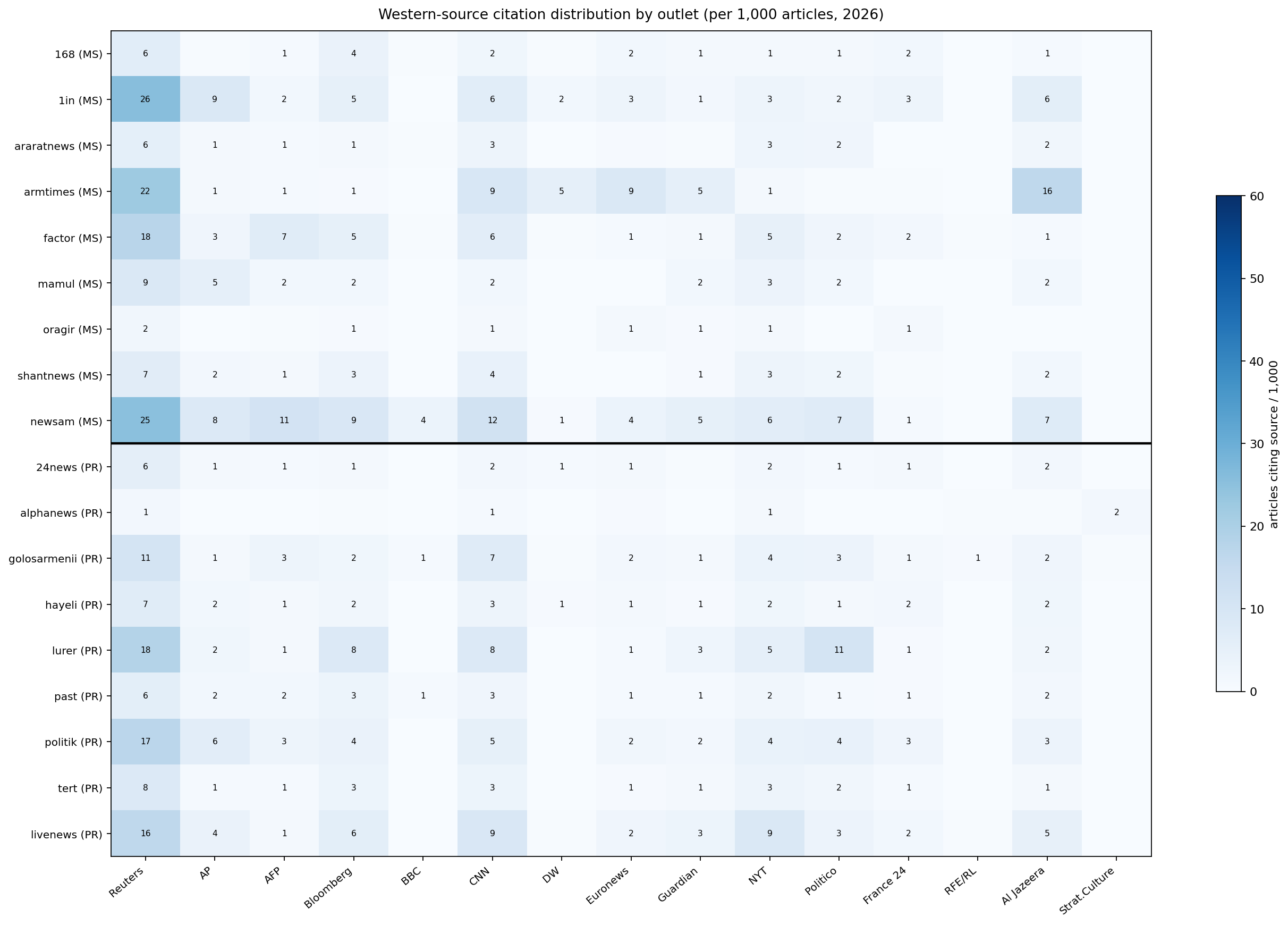
The mainstream's own sourcing tilted decisively West: its citation of Western outlets climbed from roughly 60 to about 160 mentions per 1,000 articles between the two windows, and by election season it leaned on the Western news agencies (Reuters, AP, AFP) more than on Russian ones — a reversal of the 2025 balance.
Most-cited Western outlets, 2026 (mentions)
Mainstream
- Reuters — 2,006
- CNN — 932
- Bloomberg — 736
- Politico — 467
- AFP — 465
- AP — 413
- NYT — 390
Pro-Russian
- Reuters — 1,981
- CNN — 1,099
- Politico — 914
- Bloomberg — 889
- NYT — 585
Both clusters cite establishment Western media heavily. The pro-Russian cluster does so largely neutrally, as ordinary international-news wires, though per 1,000 articles still far below the mainstream (~37 vs ~158). The mainstream's one lingering Russian-facing habit runs through a single outlet, factor.am, which reaches not for the Kremlin's state press but for exiled, anti-Kremlin Russian journalism such as The Insider and Meduza.
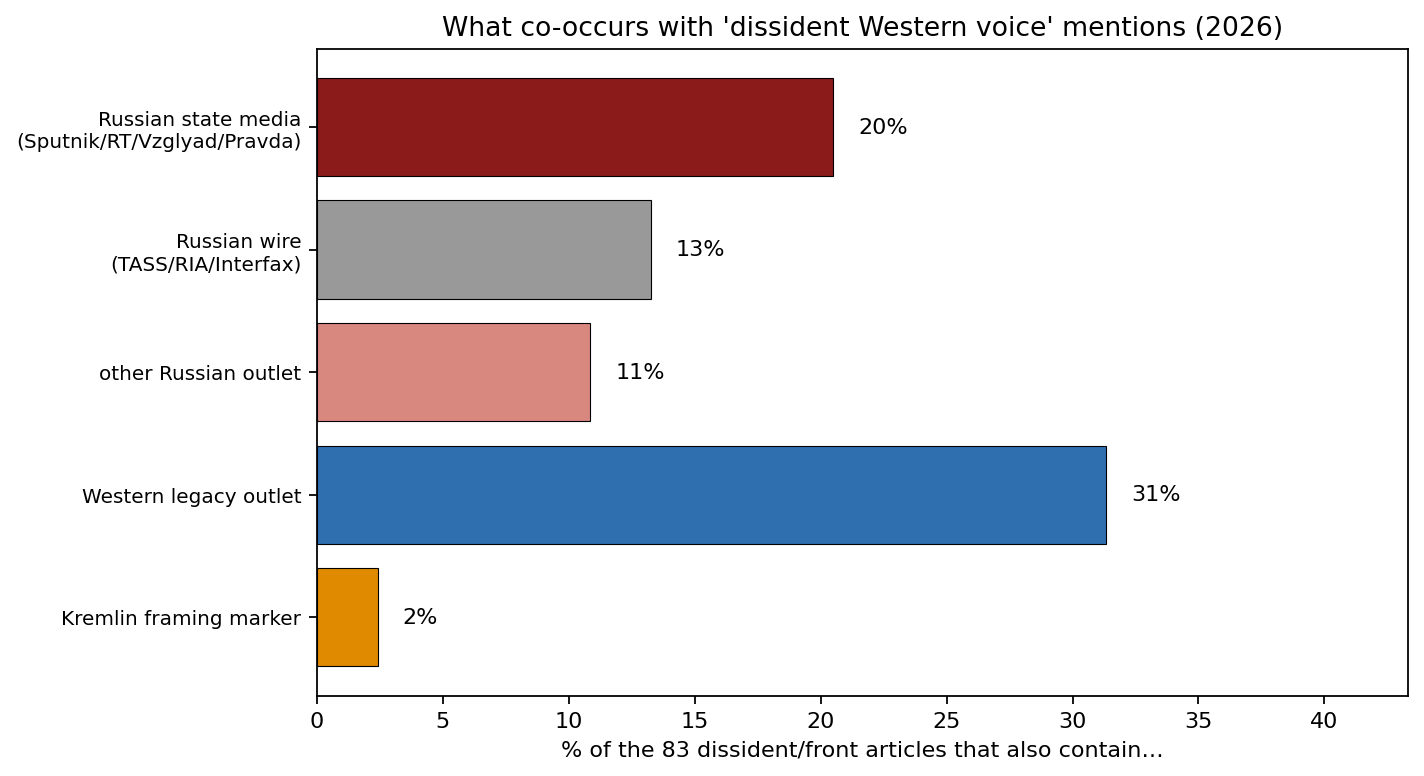
Beside its neutral use of Western wires, the pro-Russian cluster has a smaller validation-and-weaponisation layer: Western or Western-sounding voices quoted to carry a Kremlin frame.
- Strategic Culture Foundation — a US-sanctioned, intelligence-linked outlet whose expert Andrey Areshev is a standing commentator on Alphanews, framing Armenia's EU turn as Western sabotage (25 articles).
- Berliner Zeitung — a Berlin daily with a documented Russia-friendly editorial line, used above all to recycle a single interview with the detained pro-Russian tycoon Samvel Karapetyan as outside endorsement.
- About 19 op-eds, concentrated in livenews, that cite a Western outlet inside a Kremlin frame (for example NYT quoted within "Russia's SVO against fascist, neo-Nazi Ukraine"), on the Iran–US war and US "hegemony", the Ukraine war, and Armenia's Western pivot.
This layer stays inside the pro-Russian cluster: none of the 19 Western-plus-frame articles cross into a mainstream outlet. It is a register the cluster talks to itself in, not a demonstrated channel of mainstream penetration.